Analysis
We provide a analyzes of the non-ferrous metal scrap market
We are a provider of comprehensive non-ferrous metal scrap market analyses. Wes use advanced technology and reliable data sources to deliver accurate market trends, pricing information and more. Our goal is to help you make informed decisions and achieve your business goals.
How can we help you?
We prepare opinions and analyzes of the non-ferrous metal scrap market in the European Union.
Data
Data acquisition is the process of gathering and collecting information from various sources using different techniques and methods.
Data Processing
Data processing is the process of collecting and manipulating data to extract meaningful information. This involves a series of steps, including data collection, data entry, data validation, data analysis, data transformation, and data visualization.
Data Analysis
Data analysis involves examining raw data with the aim of identifying patterns, relationships, and trends, and then drawing meaningful conclusions from such observations. Data analysis is an essential tool in problem-solving and decision-making processes across different industries, including healthcare, finance, marketing, and more.
Market Size
The concept of market size refers to the measurement of the magnitude of a particular market in terms of the potential opportunities it offers for businesses to grow, become more profitable, and expand their operations. It is a crucial aspect of market analysis since it provides businesses with a clear understanding of the size, growth rate, and demand patterns of their target market.
Forecasts
The scrap market in Europe has been experiencing a number of changes in recent years due to numerous factors such as economic growth, decreased availability of raw materials, and the rising popularity of sustainability initiatives. While the future prospects for the scrap market in Europe remain uncertain, many experts believe that the market will continue to grow and evolve as businesses seek out more environmentally-friendly and cost-effective solutions for their material needs.
Opinions
When it comes to preparing for anything in life, it's important to have opinions and perspectives from different sources. This allows us to broaden our perspective and consider different approaches to preparation. It's helpful to seek advice from experts and professionals in the field, as they often have invaluable insights to share.
"Right decisions based on good data and analysis."
Analysis: Import and Export of Non-ferrous Metals Scrap EU-27 Countries
(nformation prepared on the basis of Eurostat data)
Import of aluminum scrap (2015 - 2023)
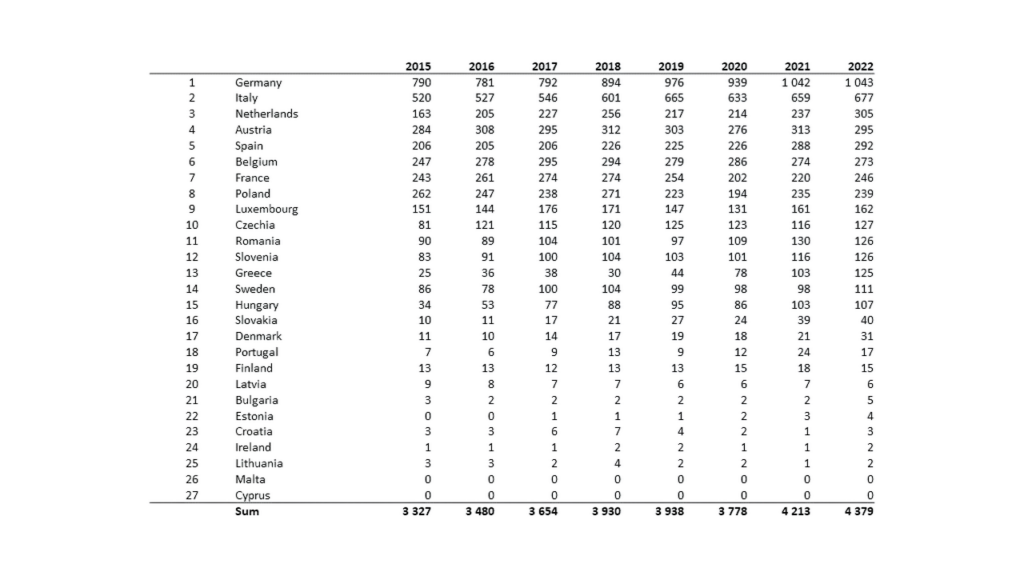
The data from Eurostat on aluminum scrap imports (in thousand tons) between 2015 and 2023 reveal several interesting trends across European countries. Overall, the total volume increased from 3,327 thousand tons in 2015 to a peak of 4,325 thousand tons in 2022 before experiencing a slight decline to 4,100 thousand tons in 2023. Many of the leading importers—such as Germany, Italy, Spain, and Austria—show a general upward trend over the period, with noticeable growth starting around 2018. However, in 2023, some countries experienced a modest downturn compared to the previous year, indicating either market corrections or adjustments following the post-pandemic recovery phase.
Detailed Analysis of Poland’s Position
Poland’s performance in the aluminum scrap market has been moderate when compared with the top European importers. Here is a closer look at its data:
2015–2017:
Poland began with an import volume of 262 thousand tons in 2015. This figure then slightly declined to 247 thousand tons in 2016 and further to 238 thousand tons in 2017, suggesting an initial period of moderate contraction or stabilization.2018 Peak and Subsequent Decline:
In 2018, imports increased to 271 thousand tons—a brief rebound that positioned Poland at its highest level within the dataset. However, this was followed by a decrease to 223 thousand tons in 2019 and an even sharper drop to 194 thousand tons in 2020. The decline during these years may reflect economic challenges or disruptions in the market, possibly linked to broader economic conditions or the impact of the COVID-19 pandemic.Post-2020 Recovery and Stabilization:
After the dip in 2020, Poland experienced a modest recovery. The import volume rose to 235 thousand tons in 2021 and then stabilized around 239 thousand tons in 2022 and 241 thousand tons in 2023. Although there is clear evidence of recuperation after the downturn, the recovery has been gradual rather than robust.Relative Market Share:
While Poland remains an important player in the European aluminum scrap market, its share relative to the total market has slightly diminished over the period. In 2015, Poland’s imports represented approximately 7.9% of the total (262 out of 3,327 thousand tons), but by 2023 this share had dropped to about 5.9% (241 out of 4,100 thousand tons). This suggests that while Poland has maintained a stable import volume in recent years, other countries—especially the leading markets—have grown at a faster rate.
Summary
In summary, the European aluminum scrap import market has generally grown from 2015 to 2022, with a slight retrenchment in 2023. Poland’s import figures show a similar pattern of initial fluctuation—with a peak in 2018 followed by a significant decline in 2019–2020—and then a gradual recovery and stabilization in the most recent years. Despite this recovery, Poland’s relatively modest import volumes and its declining share of the overall market indicate that it plays a more moderate role compared to major importers like Germany and Italy.
Values in thousands of tons
Export of aluminum scrap (2015 - 2023
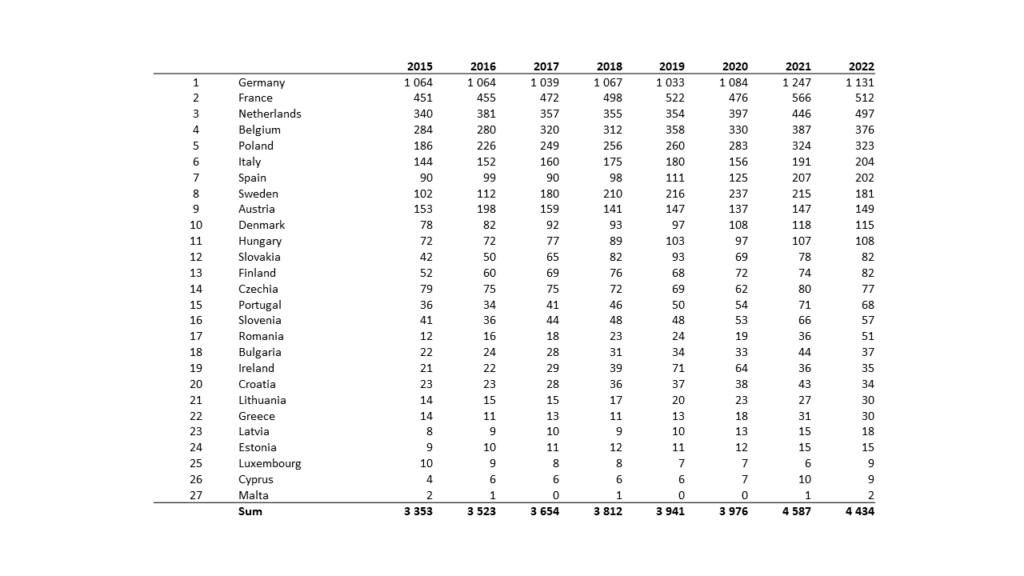
The Eurostat data on aluminum scrap exports (in thousand tons) from 2015 to 2023 reveal an overall upward trend in the European market with some fluctuations in recent years. Total exports increased from 3,353 thousand tons in 2015 to a peak of 4,590 thousand tons in 2021. After this peak, exports experienced a slight decline to 4,412 thousand tons in 2022, followed by a modest recovery to 4,500 thousand tons in 2023. This evolution suggests that while the overall market has grown steadily, there have been some minor corrections or adjustments in the most recent years.
General Trends
- Leading Exporters:
Germany consistently remained the largest exporter, with figures around 1,064 thousand tons in 2015–2016, a small dip in 2017, and then rising to 1,247 thousand tons in 2021. France, the Netherlands, and Belgium also maintained strong and relatively stable export volumes throughout the period, with gradual increases and minor year-to-year variations. - Market Fluctuations:
Although most countries experienced steady growth from 2015 up to 2021, several of them saw a slight reduction in export volumes in 2022 and 2023, reflecting possible market adjustments or external factors influencing the trade of aluminum scrap.
Poland’s Position
Poland’s export performance shows a clear, steady improvement over the nine-year period:
Growth Trajectory:
- In 2015, Poland exported 186 thousand tons of aluminum scrap.
- By 2016, exports had risen to 226 thousand tons, and this upward trend continued in subsequent years, reaching 249 thousand tons in 2017 and 256 thousand tons in 2018.
- In 2019, the export volume further increased to 260 thousand tons.
Continued Expansion and Peak:
- The growth momentum did not stop in 2019; in 2020, exports climbed to 283 thousand tons.
- The upward trend culminated in 2021 when Poland achieved its highest export volume of 324 thousand tons, marking a significant improvement compared to its starting point in 2015.
Recent Adjustments:
- After the 2021 peak, there was a slight stabilization with 323 thousand tons recorded in 2022 and a minor decline to 310 thousand tons in 2023.
- Although these last two years indicate a small setback, the overall trend since 2015 remains positive.
Market Share and Importance:
- Over the years, Poland’s share of the total European aluminum scrap exports has grown. In 2015, its 186 thousand tons represented roughly 5.5% of the total exports (3,353 thousand tons).
- By 2021, with 324 thousand tons out of 4,590 thousand tons, Poland’s share had increased to approximately 7%, underlining its rising importance in the European market.
Comparative Standing:
- While Poland is not among the very top exporters (with Germany, France, the Netherlands, and Belgium leading), its consistent growth and the notable increase in its export volume over the period have solidified its position as a significant player in the sector.
- The steady expansion of Poland’s exports indicates improved competitiveness or a strategic emphasis on the aluminum scrap sector, even though recent figures suggest a need to monitor the slight downturn after the 2021 peak.
Conclusion
In summary, the European aluminum scrap export market has shown robust growth from 2015 through 2021, with a minor dip and partial recovery in the following years. Poland’s export figures, rising from 186 thousand tons in 2015 to a peak of 324 thousand tons in 2021, demonstrate a strong upward trend and an enhanced role in the market. Despite a slight decline in 2023, Poland remains a steadily growing and important exporter in the European aluminum scrap industry.
Values in thousands of tons
Import of copper scrap (2015 - 2023)
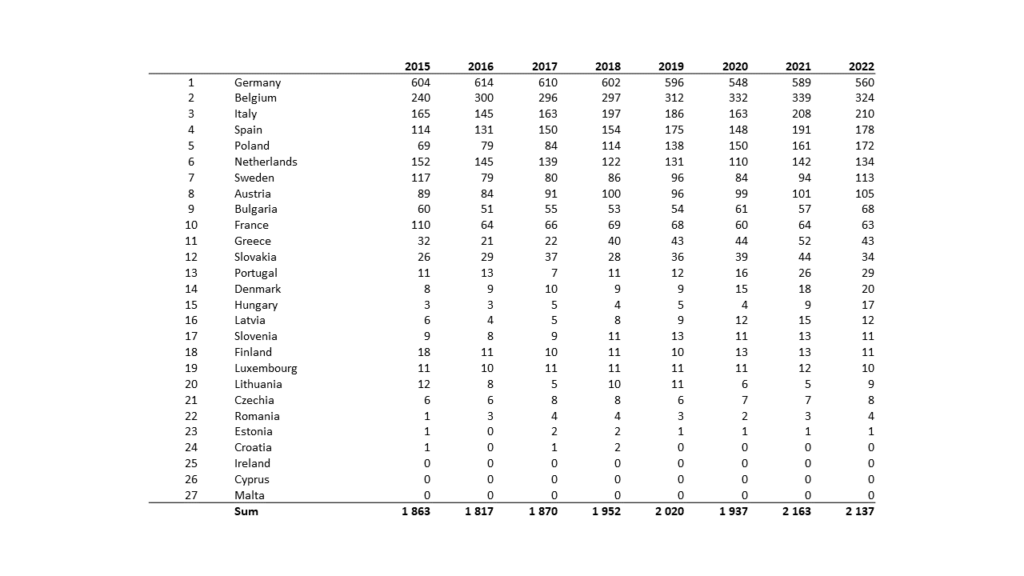
The Eurostat data on copper scrap imports (in thousand tons) from 2015 to 2023 show an overall expansion of the market with noticeable fluctuations in recent years. Overall, total imports increased from 1,863 thousand tons in 2015 to a peak of 2,164 thousand tons in 2021. After this peak, there was a decline to 2,133 thousand tons in 2022 and a further drop to 1,904 thousand tons in 2023, indicating a recent contraction in the market.
General Trends
-
Market Evolution:
Between 2015 and 2019, the market experienced a gradual growth, rising from 1,863 to 2,020 thousand tons. Although 2020 saw a slight dip to 1,938 thousand tons—possibly reflecting pandemic-related disruptions—the market rebounded in 2021 before declining again in 2022 and 2023. -
Country-Specific Movements:
Major importing countries like Germany, Belgium, Spain, and Italy exhibit varied trends. For example, Germany’s imports fluctuated slightly but showed an overall declining trend from 604 thousand tons in 2015 to 503 thousand tons in 2023. Similarly, Belgium and Spain experienced increases until 2021 followed by declines in the subsequent years, suggesting that recent market conditions have impacted many countries in a similar way.
Poland’s Position
Poland’s performance in the copper scrap import market has been particularly noteworthy:
-
Steady Growth Until 2022:
- In 2015, Poland imported 69 thousand tons of copper scrap.
- This figure increased steadily over the years—79 thousand tons in 2016, 84 thousand tons in 2017, and a more pronounced jump to 114 thousand tons in 2018.
- By 2019, imports reached 138 thousand tons, followed by 150 thousand tons in 2020 and peaking at 161 thousand tons in 2021.
- In 2022, Poland’s imports further climbed to 172 thousand tons, marking a significant expansion from the 2015 baseline.
-
Recent Decline in 2023:
In 2023, Poland’s copper scrap imports decreased to 154 thousand tons. While this drop mirrors the overall market contraction seen across Europe in the most recent year, it comes after nearly a decade of continuous growth. -
Increasing Market Share:
Poland’s rising import figures have also enhanced its relative position within the European market. In 2015, Poland’s share of the total imports was about 3.7% (69 out of 1,863 thousand tons). By 2022, this share had grown to approximately 8.1% (172 out of 2,133 thousand tons), demonstrating that Poland has become a more significant player in the copper scrap market over time. -
Industry Implications:
The long-term upward trend until 2022 suggests that Poland has experienced increasing domestic demand for copper scrap, potentially driven by industrial growth or improved recycling practices. Despite the recent decline in 2023, the overall trend indicates that Poland is emerging as an important consumer in the European copper scrap market, even though it still ranks behind the larger markets such as Germany, Belgium, Spain, and Italy.
Conclusion
In summary, the European copper scrap import market grew from 2015 to 2021 before experiencing a downturn in 2022 and 2023. Poland, in particular, demonstrated robust growth from a modest 69 thousand tons in 2015 to a peak of 172 thousand tons in 2022, effectively increasing its market share. Although there was a decline to 154 thousand tons in 2023, Poland’s overall upward trend over the period highlights its rising importance in the European copper scrap market.
Values in thousands of tons
Export of copper scrap (2015 - 2023)
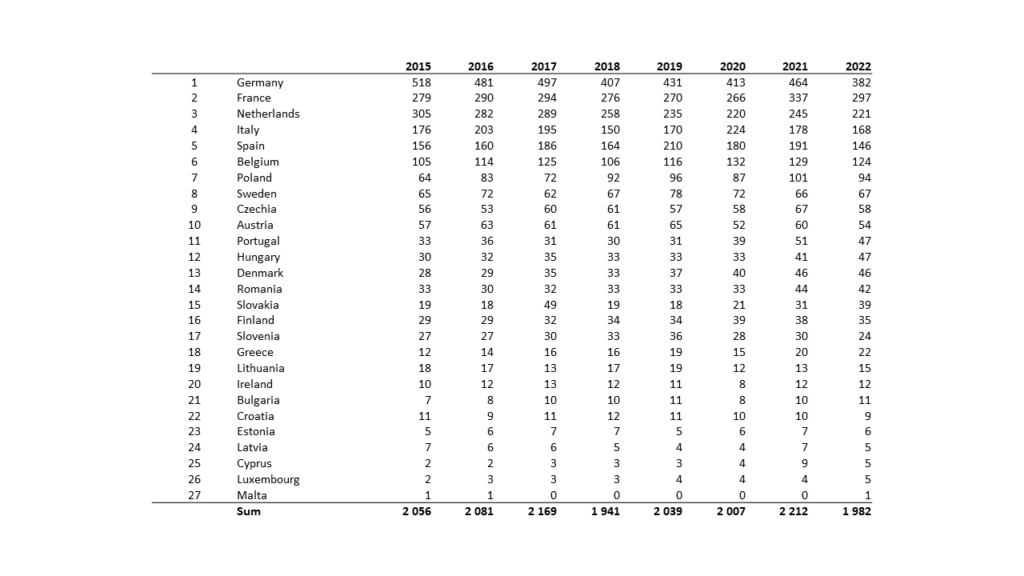
The Eurostat data on copper scrap exports (in thousand tons) for 2015–2023 reveal a fluctuating market with a general peak in 2021, followed by a decline in subsequent years. Overall, total exports increased from 2,056 thousand tons in 2015 to a high of 2,213 thousand tons in 2021. However, this was followed by a drop to 1,975 thousand tons in 2022 and a further decrease to 1,897 thousand tons in 2023, indicating a contraction in the market after the 2021 peak.
Overall Trends
Market Fluctuations:
The overall European copper scrap export market experienced modest growth between 2015 and 2021, with the highest export volume recorded in 2021. The subsequent decline in 2022 and 2023 suggests that the market may be experiencing cyclical adjustments or external pressures affecting export volumes.Major Exporters:
Countries such as Germany, France, the Netherlands, Italy, Spain, and Belgium have been the leading players in this market. For instance, Germany’s exports started at 518 thousand tons in 2015, reaching 464 thousand tons in 2021 before declining to 377 thousand tons in 2023. Similar downward trends in the most recent years can also be observed in other large exporters like France and the Netherlands.
Poland’s Position
Poland’s performance within the copper scrap export market shows both growth and variability over the period:
Initial Growth and Fluctuations:
- In 2015, Poland exported 64 thousand tons of copper scrap.
- Exports increased to 83 thousand tons in 2016 but then dipped to 72 thousand tons in 2017.
- A recovery followed in 2018, with exports rising to 92 thousand tons, and further increasing to 96 thousand tons in 2019.
Peak and Subsequent Decline:
- In 2020, exports slightly declined to 87 thousand tons but then reached a peak of 101 thousand tons in 2021.
- Following this peak, Poland’s exports decreased to 94 thousand tons in 2022 and further to 85 thousand tons in 2023.
Relative Market Share:
- In 2015, Poland’s share of the total European copper scrap exports was approximately 3.1% (64 out of 2,056 thousand tons).
- By 2021, at its peak of 101 thousand tons, its share had risen to roughly 4.6% (101 out of 2,213 thousand tons).
- Despite the decline in 2022 and 2023, Poland’s export levels remain significantly higher than its 2015 baseline, and its improved market share reflects an increased role in the European market.
Implications:
Although Poland is not among the very top exporters, its steady growth until 2021 and the corresponding increase in its share of the overall market suggest that it has become a more important player in the copper scrap export sector. The subsequent decline in exports during 2022 and 2023 appears to mirror the broader market contraction, rather than indicating a country-specific downturn.
Conclusion
In summary, the European copper scrap export market experienced growth up to 2021, followed by a contraction in the last two years. Poland’s export performance, marked by an increase from 64 thousand tons in 2015 to a peak of 101 thousand tons in 2021, illustrates a modest but significant rise in its market role. Despite the recent declines in 2022 and 2023, Poland’s increased market share over the period highlights its growing importance in the European copper scrap export landscape.
Values in thousands of tons